
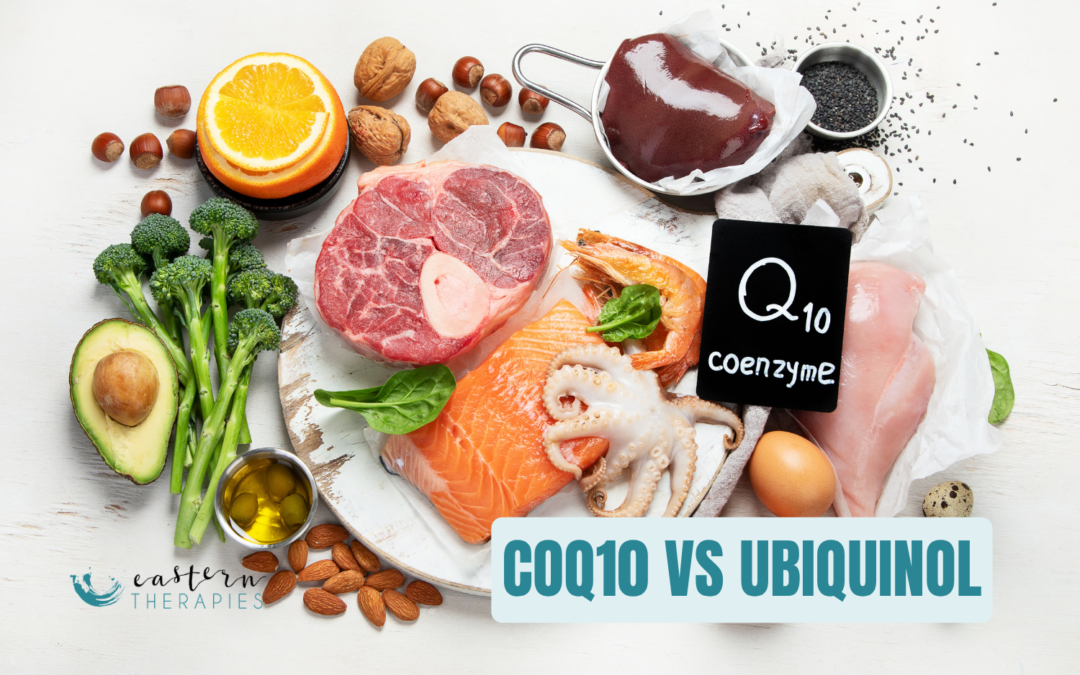
If you’ve ever been told to take CoQ10 — whether for fertility, energy, or general health — you’ve probably noticed something confusing on the shelf: some products say “ubiquinone,” and others say “ubiquinol.” Both call themselves CoQ10. Both claim to support energy and antioxidant function. So what’s the difference, and does it actually matter?
The short answer: yes, it does matter — especially if you’re in your mid-30s or beyond, supporting your fertility, or dealing with chronic fatigue or oxidative stress.
CoQ10 is the umbrella name. Ubiquinone and ubiquinol are the two forms it comes in — and only one of them is ready to use.
What Is CoQ10?
CoQ10 (Coenzyme Q10) is a naturally occurring molecule found in almost every cell in your body. Think of it like the word “vitamin C” — it describes the nutrient, but it doesn’t tell you what form it’s in.
CoQ10 exists in two interconvertible forms:
- Ubiquinone — the oxidised (inactive) form
- Ubiquinol — the reduced (active) form
Your body constantly converts between the two, but it’s ubiquinol that does the heavy lifting.
What Does CoQ10 Actually Do in Your Body?
CoQ10 plays two essential roles:
1. Energy production
CoQ10 sits inside your mitochondria — the tiny power stations inside every cell — and helps generate ATP, the fuel your body runs on. Without adequate CoQ10, mitochondrial function suffers, and so does your energy.
2. Antioxidant protection
CoQ10 is a potent antioxidant that neutralises free radicals before they can damage cells, DNA, and — critically for fertility — eggs.
Ubiquinone vs Ubiquinol: The Key Difference
Here’s an analogy that helps:
Ubiquinone is like flat-pack furniture. It arrives in a box and needs to be assembled before you can use it. Ubiquinol is like furniture that arrives already built — ready to use straight away.
Most CoQ10 supplements on the market contain ubiquinone. It’s cheaper to produce and has a longer shelf life. But for your body to actually use it, it has to convert ubiquinone into ubiquinol first.
In younger, healthier people, this conversion happens reasonably well. The problem? It becomes significantly less efficient as we age, under chronic stress, when oxidative load is high, or when certain medications — like statins — are involved.
In these situations, ubiquinol is the smarter choice. The conversion work is already done.
Why CoQ10 Matters So Much for Fertility
This is where the ubiquinone vs ubiquinol distinction becomes clinically significant.
Eggs (oocytes) are the most energy-demanding cells in the human body. They need enormous amounts of ATP to mature properly, fertilise successfully, and develop into a healthy embryo.
As women age — particularly from the mid-30s onwards — two things happen simultaneously:
- The mitochondria inside eggs naturally become less efficient
- The body’s own CoQ10 production declines
This is one of the key reasons egg quality can decrease with age — and it’s one of the reasons supplementing with ubiquinol specifically has become a focus in integrative fertility support.
What ubiquinol supports in the context of fertility:
- Mitochondrial energy production inside the developing egg
- Protection of egg DNA from oxidative damage
- Embryo development quality
For this reason, at Eastern Therapies we recommend ubiquinol specifically for fertility patients — not just any CoQ10.
When to Consider Ubiquinol Over Ubiquinone
Ubiquinol is worth discussing with your practitioner if:
- You are over 35 and trying to conceive
- You are preparing for IVF or an egg retrieval cycle
- You are experiencing unexplained fatigue or low energy
- You are under chronic stress
- You are currently taking statin medication
- You have had previous IVF cycles with poor egg quality or fertilisation rates
How to Read the Label
When you pick up a CoQ10 supplement, check the label carefully:
- Says “CoQ10” only → almost certainly ubiquinone (inactive form)
- Says “ubiquinol” → you have the active form
- Doesn’t specify → ask your practitioner before purchasing
Ubiquinol supplements are typically more expensive, and they require careful storage (they’re sensitive to heat and light). But for the right patient, the difference in bioavailability can be significant.
A Note on Dosage
Dosage depends on your individual situation, age, health history, and what you’re using CoQ10 for. Research in fertility contexts has used a wide range of doses. This is not a one-size-fits-all supplement, and “more” is not always better.
If you’re already taking a CoQ10 supplement and aren’t sure which form it is — or whether the dose is appropriate for your goals — this is worth reviewing with a practitioner who understands your full picture.
Want to Know What’s Right for Your Fertility Journey?
At Eastern Therapies in Bondi Junction, we take a whole-body, integrative approach to fertility and hormonal health — combining Chinese Medicine diagnostics with functional medicine principles to understand what’s actually driving your symptoms.
If you’d like clarity on whether ubiquinol is appropriate for your stage of the fertility journey, book a consultation at Eastern Therapies in Bondi Junction and get a plan that’s tailored to your body.