Exploring Richard Tan’s Balance Method Acupuncture
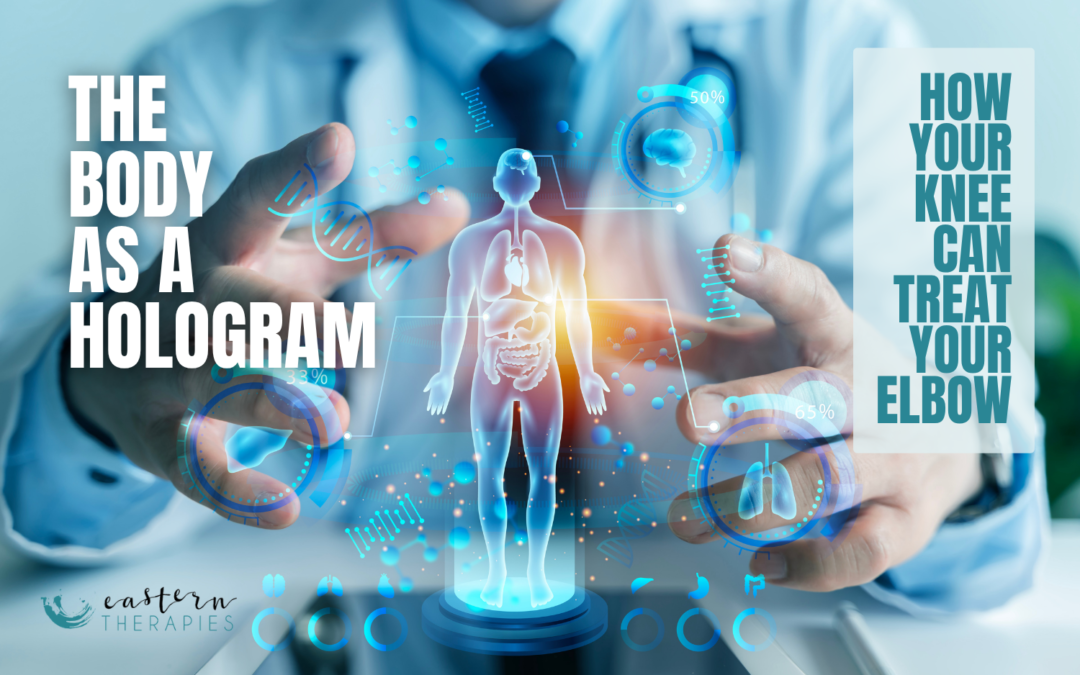
In modern medicine, pain is usually treated where it appears. If your elbow hurts, most treatments focus on the elbow itself. In classical Chinese medicine and Richard Tan’s Balance Method acupuncture, the body is viewed very differently. Your body is seen as a hologram: each part reflects and connects to every other part. This means a knee point can be used to treat an elbow problem—and often with surprising speed and effectiveness.
In this article, we’ll explore how the Body-as-a-Hologram concept works, what the Balance Method is, and why so many people seek it out for pain relief and whole‑body balance.
What Is the “Body as a Hologram” Concept?
A hologram is an image where every part contains information about the whole. When we apply this idea to the body, it suggests that each region contains a “map” of the entire system. In Eastern medicine, this is reflected in microsystems like the ear, hand, scalp, and foot. Treating one small area can influence distant regions because energy and information are interconnected.
In the holographic view of the body:
- The body is an integrated energy network, not a collection of isolated parts.
- One area can mirror, reflect, or represent another (for example, the ankle reflecting the neck, or the hand reflecting the torso).
- Pain is often seen as a sign of energy blockage or imbalance somewhere along these networks, not just local tissue damage.
Richard Tan’s Balance Method builds on this holographic principle and applies it in a very systematic way.
An Introduction to Richard Tan’s Balance Method
Richard Tan’s Balance Method is a style of acupuncture that focuses on using distal (distant) points to treat pain and internal conditions. Instead of needling directly where it hurts, the practitioner selects balancing meridians and points in other parts of the body to restore harmony along the channel where pain is located.
Some key features of the Balance Method include:
- Using meridian relationships and holographic body maps to choose treatment points.
- Treating pain on one side of the body by needling the opposite side.
- Using points below the elbows and knees to affect issues higher up in the body.
- A strong emphasis on achieving noticeable change during the session itself.
This approach allows many patients to lie comfortably while the acupuncturist works on points far away from the painful area—yet the relief can be felt almost immediately.
How Can the Knee Treat the Elbow?
One of the most fascinating aspects of the Balance Method is how it explains cross-body and cross-joint treatment, like using the knee to treat the elbow.
Here’s a simplified way to understand it:
- Meridian correspondence:
In Chinese medicine, energy channels called meridians run through the body, connecting joints, muscles, and organs. When the meridian that passes through the elbow is imbalanced, pain or dysfunction can show up there. The Balance Method identifies other meridians and body regions that “balance” or mirror this channel. - Holographic mapping:
The body is divided into regions where one area can represent another. The upper limb (shoulder–elbow–wrist) can be mirrored in the lower limb (hip–knee–ankle). In this model, the elbow and knee often line up as corresponding points. - Distal needling for local pain:
Instead of inserting needles directly into a painful elbow, an acupuncturist might select points around the opposite or corresponding knee. By stimulating these distal points, they aim to correct the energetic imbalance affecting the elbow. - Real-time feedback:
In a typical Balance Method session, the practitioner will needle the chosen points and then ask the patient to move the painful joint. If the point selection is correct, the pain level often drops within minutes, confirming the holographic and meridian-based relationships.
So, although it may seem counterintuitive from a purely anatomical perspective, in this energetic and holographic framework the knee becomes an effective gateway to influence and relieve elbow pain.
What a Balance Method Session May Feel Like
A Balance Method treatment usually begins with a detailed assessment of where you hurt and how the pain behaves. The practitioner then identifies:
- Which meridian(s) are involved.
- Which side of the body and which joint levels are affected.
- Which corresponding regions—such as the knee for the elbow—should be used for treatment.
Very fine needles are placed into carefully chosen distal points, often on the arms, legs, hands, or feet. Many people feel a mild, dull ache, warmth, or spreading sensation around the needle site. After the needles are placed, the practitioner may ask you to gently move the area that was hurting.
Patients often notice:
- Reduced pain intensity
- Greater range of motion
- A sense of relaxation or lightness in the body
- Improved symmetry or balance between left and right sides
These immediate changes are part of what makes the Balance Method so attractive for pain management and functional issues.
Benefits of the Body-as-a-Hologram Approach
Viewing the body as a hologram and using the Balance Method can offer several practical benefits:
- Holistic perspective: Instead of chasing symptoms in one spot, this approach looks at patterns throughout the entire body’s energy system.
- Gentle on sensitive areas: Painful or injured joints do not need to be directly needled, which can be more comfortable for many people.
- Real-time results: Because of its emphasis on immediate feedback, both practitioner and patient can often see changes during the same session.
- Application to many conditions: While it is well known for musculoskeletal pain, the holographic and meridian-based framework is also used to support headaches, digestive discomfort, menstrual issues, and stress-related symptoms.
By emphasizing balance across the whole network of the body, this method often leads to improvements in areas the patient didn’t initially mention—better sleep, improved mood, or a deeper sense of well‑being.
Is Balance Method Acupuncture Right for You?
If you are curious about Eastern therapies and are looking for a different way to address pain, stiffness, or stubborn aches, exploring Richard Tan’s Balance Method acupuncture may be worthwhile. It is especially appealing if:
- You prefer a more holistic, systems-based understanding of your body.
- You are uncomfortable with needles directly in painful joints.
- You are seeking approaches that integrate traditional wisdom with a clear, structured method.
As with any healthcare choice, it is important to work with a qualified practitioner who is trained in this specific style of acupuncture. They can assess your condition, explain how the Body-as-a-Hologram concept applies to your situation, and design a treatment plan tailored to your needs.
Bringing It All Together
The idea that your knee can treat your elbow is more than a metaphor; it reflects a sophisticated view of the body as an interconnected, holographic system. Through Richard Tan’s Balance Method acupuncture, distal points—often below the elbows and knees—are used to influence and rebalance other areas of the body, providing relief without directly needling the painful site.
For many people, this approach becomes an accessible entry point into Eastern therapies: it blends ancient meridian theory with a modern, results‑oriented framework and invites us to see the body not as disconnected parts, but as a unified, responsive whole.